 TheGameHosting Team

Rust's server.cfg is a plain text file in server/<your identity>/cfg/. The server reads it at startup and it takes priority over start options. Write one setting per line, without the + sign, such as server.maxplayers 50, then restart the server so it loads.
Where is the Rust server.cfg file?
Facepunch's Creating a server guide puts it here:
server/<your identity>/cfg/server.cfg<your identity> is the name you gave +server.identity in your start options. Three rules from the same guide:
- The server reads the file at startup, and what it says wins over anything set on the command line.
- Facepunch says the server does not touch this file, so you change it by hand.
- You leave out the
+or-that start options use. In the file you writeserver.maxplayers 10, not+server.maxplayers 10.
If you do not see the file, create it. Our File Manager has a button for new files. The same cfg folder holds your admin list (users.cfg) and your ban list, so never delete the folder. For admins, see how to become admin on a Rust server.
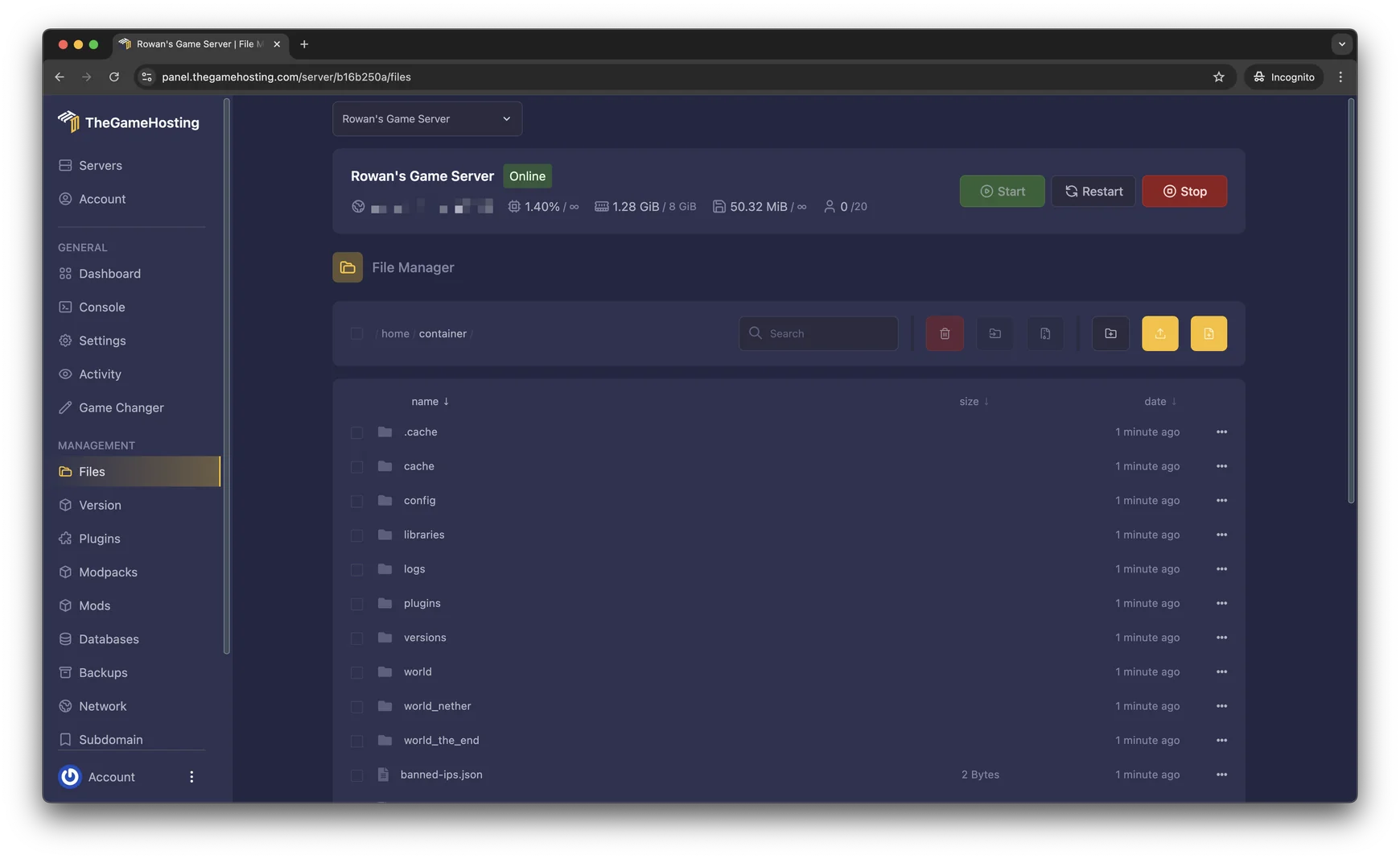
How to edit server.cfg in the panel
- Back up the server from the Backups page.
- Open Files, then go to
server, your identity folder andcfg. - Open
server.cfgin the editor, or create it with the new file button. - Change or add lines. One setting per line.
- Save the file and restart the server. The server only reads the file when it starts.
A starter server.cfg
This example uses the settings Facepunch documents. Change the values to fit your server.
server.hostname "My Rust Server | Weekly | Vanilla"
server.description "Fair rules, active admins. Be kind to new players."
server.url "https://example.com"
server.maxplayers 50
server.tags weekly,vanilla
decay.scale 1
Text with spaces goes inside double quotes. Tags do not.
The settings that matter
All of these come from Facepunch's wiki pages: Creating a server, useful commands and server browser tags.
| Setting | What it does | Notes |
|---|---|---|
server.hostname | The name shown in the server list | Keep it short and clear |
server.description | Text shown in the connection window | Put your rules or a Discord link here |
server.url | Your website | Optional |
server.headerimage | The picture players see | Optional, give it an image link |
server.maxplayers | Player limit | More players need a faster CPU |
server.tags | Tags that help players find you | See the next section |
decay.scale | How fast buildings decay | Default is 1 |
decay.upkeep_period_minutes | The upkeep period | Default is 1440 |
server.pve | Turns on the PvE tag | Also applies the pve tag |
censorplayerlist | Hides player names from list scrapers | Set true to turn on |
Map size and seed (server.worldsize, server.seed) are usually start options, since they decide the map before it loads. How to wipe a Rust server shows how to change them for a new map.
Start options or server.cfg: which one?
Most variables work in either place, and the file wins when both set the same thing. A sensible split:
| Put it in | Settings |
|---|---|
| Start options | server.identity, server.port, server.level, server.seed, server.worldsize, rcon.port, rcon.password, rcon.web, -logfile |
server.cfg | Name, description, URL, player limit, tags, decay and other rules you change often |
The first group is the example line from Facepunch's guide. It decides where the server lives and what map it builds, so it rarely changes. The second group is what you tune over a wipe. Keeping the two apart makes it easier to see what changed when something breaks.
The Rust+ app port
The Rust+ companion app talks to the server on its own TCP port, set with app.port. By default it is the game port plus 67, or the RCON port plus 67, whichever is larger. That gives 28082 with the default ports. If you set it yourself it has to be 10000 or higher, and app.info in the console shows what the server is using. How to make a Rust server lists all four ports.
Server browser tags
Tags tell players what kind of server you run. Set them with a comma-separated list:
server.tags weekly,vanilla,NAFacepunch's list of values:
- Wipe schedule:
monthly,biweekly,weekly. - Difficulty:
vanilla,hardcore,softcore. - Mode and type:
pve,roleplay,creative,minigame,training,battlefield,broyale,builds,tut,premium. - Region:
NA,SA,EU,WA,EA,OC,AF.
Two rules matter. The browser displays up to four tags. And using several tags from the same group on one server, such as both weekly and monthly, "will not work properly with search" and can make the server vanish from some tag searches. Pick one per group. If your server does not show up, read Rust server not showing in the server list.
Change a setting while the server is running
Type a setting in the server console and it applies at once. It may not survive a restart, though. Facepunch describes server.writecfg as the command that "writes server convars/settings to the cfg files". The wiki gives that one-line description and does not say exactly which lines it saves, so the dependable method is to edit server.cfg yourself. That file is what loads on the next start.
Two more notes from Facepunch:
- Some variables only work after the server is running, such as the weather chance settings. They are ignored in the file.
- Not sure of a setting's name? Type
findfollowed by a word in the console, for examplefind decay.
find decayWhy my server.cfg changes are ignored
- You did not restart. The file is read at startup.
- The file is in the wrong folder. It must be inside
cfgunder your identity folder, and the identity name must match your start options. - You kept the
+sign. The file does not use it. - A typo in the setting name. Use
findto check the exact name. - The setting needs a running server. The weather chance variables are one example.
FAQ
Where is the server.cfg file in Rust?
In server/<your identity>/cfg/server.cfg, where the identity is the name from your +server.identity start option. Create the file if it does not exist yet.
Does server.cfg override start options?
Yes. Facepunch says the server reads server.cfg at startup and that it takes priority over anything set on the command line.
Do I put a plus sign in front of settings in server.cfg?
No. Write server.maxplayers 10, not +server.maxplayers 10. The plus sign is for start options only.
What does server.writecfg do?
Facepunch describes it as writing server convars and settings to the cfg files. Editing server.cfg by hand and restarting is the most reliable way to keep a setting.
How do I set server tags in Rust?
Add server.tags followed by a comma-separated list, for example server.tags weekly,vanilla,NA. The browser shows up to four, and one tag per group works best.
How do I add a header image to my Rust server?
Set server.headerimage to the web address of an image, for example server.headerimage "https://example.com/header.jpg". Facepunch lists it as optional, and players see it when they look at your server in the list.
Hosting for this game

Written by TheGameHosting Team, the people who run our servers in Dallas and Amsterdam and answer your tickets.
All posts