 TheGameHosting Team

To make a Rust server, install the Rust Dedicated Server (Steam app 258550) with SteamCMD, start it with a hostname, map size, seed and RCON password, then open the game, query and RCON ports. The alternative is to rent a server that comes already installed. Both routes are below.
What you need before you start
Facepunch lists these as a starting point on its Creating a server page, and says they depend on how many people play:
- A PC or server running Windows, Linux or macOS.
- 12 GB of free RAM, and more for a 6000 map.
- 15 GB of free disk space. An SSD or NVMe drive is strongly preferred.
- No Steam account to install and run the server. Players do need Rust on Steam to join.
Rust servers are for the PC version of the game. Console players cannot join them. If you are not sure how much memory your world needs, read Rust server requirements: how much RAM do you need before you buy or install anything.
Option 1: run the server on your own machine
This is the free route, and the steps are the same on a home PC or on a rented Linux box.
Step 1: install SteamCMD and download the server
On Linux, these commands from Facepunch's guide create two folders, download SteamCMD and install the server into the rust folder:
mkdir rust
mkdir steamcmd
cd steamcmd
wget https://steamcdn-a.akamaihd.net/client/installer/steamcmd_linux.tar.gz
tar xvfz steamcmd_linux.tar.gz
./steamcmd.sh +force_install_dir ../rust +login anonymous +app_update 258550 validate +quit
On Windows, download SteamCMD from Valve, then run the same install line with your own folder, for example +force_install_dir C:\Rust\MyServer\. Keep +login anonymous. Without a login, the install fails with "No subscription".
Step 2: write the start command
The server reads its settings from start options. This is the example from Facepunch's wiki with the values you will change most:
RustDedicated.exe -batchmode +server.port 28015 +server.level "Procedural Map" +server.seed 1234 +server.worldsize 4000 +server.maxplayers 10 +server.hostname "My Rust Server" +server.identity "server1" +rcon.port 28016 +rcon.password CHANGE_ME +rcon.web 1 -logfile rustserverlog.txtOn Linux, edit the runds.sh start file that comes with the download and use the same options. What each one does:
+server.worldsizeis the map size. Facepunch says to use 1000 to 6000. A bigger map needs more memory.+server.seedis any number from 0 to 2147483647. The same seed and size always make the same map.+server.maxplayersis your player limit. Facepunch notes that the more players you allow, the faster the CPU has to be.+server.identitynames the folder where your map, save files andcfgfolder live.+rcon.passwordprotects remote admin. Change it. The wiki marks this value with "Change this value!!!".
Step 3: open the ports
Rust uses four ports. Open them on your router or firewall, and forward them to the machine that runs the server:
| Port | Protocol | Default | What it is for |
|---|---|---|---|
Game (server.port) | UDP | 28015 | Players connect here |
Query (server.queryport) | UDP | 28017 with the options above | The server browser asks this port about your server |
RCON (rcon.port) | TCP | 28016 in the example | Remote admin tools |
Rust+ (app.port) | TCP | 28083 with the options above | The Rust+ companion app |
Facepunch warns against forwarding a port as "both" or "all" protocols. Use the protocol in the table. If the query port is closed, the server does not appear in the list.
Step 4: start it and join
Run the start script. The first start generates the map. Larger maps take longer. Wait for Server startup complete in the console. Then start Rust, press F1 and connect:
connect localhost:28015From another PC, use the server's public IP instead of localhost. When it works, you have a Rust server.
What a home server costs you
Players can only join while your PC is on and your connection is up. Your home IP address is also the address everyone connects to. Here is how the two routes compare:
| Your own machine | A hosted Rust server | |
|---|---|---|
| Uptime | Only while your PC is on | Runs without your PC |
| Router | You open and forward four ports | Nothing to configure |
| Network attacks | Your home IP is exposed | DDoS protection on every TheGameHosting plan |
| CPU | The PC you already own | AMD 9950X / 7950X3D, up to 5.7 GHz |
| Cost | Hardware and electricity | From $6.96 USD/month |
Option 2: a hosted Rust server in 4 steps
- Pick a plan. Rust needs at least 8 GB of RAM on our list, so it runs on six of our nine plans, from 8 GB up. The 8 GB plan is $6.96 USD/month. See Rust server hosting and the full plan list.
- Choose a location. Dallas, TX suits players in the Americas. Amsterdam, NL suits Europe.
- Start the server. It is ready within 60 seconds after payment. Press Start on the Console page.
- Join. Copy the address and port shown in the panel, press F1 in Rust and type
connectfollowed by that address.
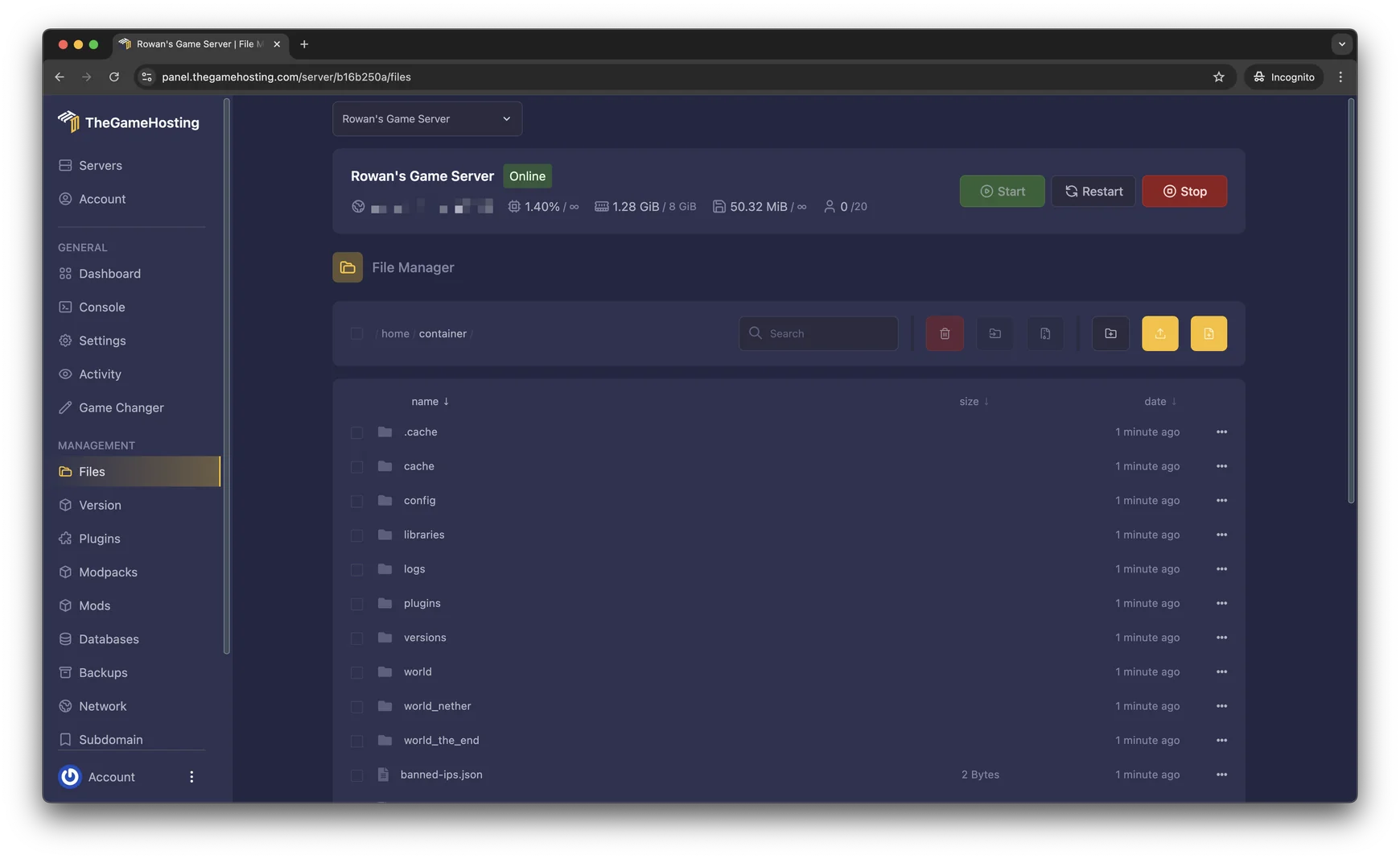
The hosted server uses the same Facepunch files and the same settings as Option 1: hostname, seed, world size, server.cfg. You edit files in the browser with the File Manager or over SFTP. If you cannot find a setting, our support team answers 24/7 in live chat.
What to do after your server is running
A fresh server is vanilla Rust. These are the usual next steps, in this order:
- Make yourself an owner, so you can use admin commands. See how to become admin on a Rust server.
- Add plugins for kits, teleports or clans. See how to install Oxide or Carbon on a Rust server.
- Plan your wipes. Facepunch forces a map wipe every month, and you can wipe more often. See how to wipe a Rust server.
- Take a backup before each of those changes. Every plan has a Backup System.
How to update your Rust server
Rust gets a monthly update, and a server on an old build cannot be joined by players on the new one. Re-run the same SteamCMD install command to update. The Windows loop in Facepunch's guide does this on every start. If you run Oxide, install the matching Oxide release after each update, because Oxide ships a new release for every Rust update.
FAQ
Do I need to own Rust to run a Rust server?
No. Facepunch says you do not need a Steam account to install and run the server. You do need a Steam account with Rust to join and play.
Can console players join a Rust server I make?
No. Servers you run are for the PC version of Rust on Steam. Rust Console Edition uses its own servers.
How many players can my Rust server hold?
You set the limit with server.maxplayers. The real ceiling is your CPU and RAM. On our plans there is no slot limit, so memory is what you size for.
How do I connect to my own Rust server?
Press F1 in Rust and type connect followed by the server address and port, for example connect localhost:28015 on the same PC.
How do I update a Rust server?
Run the SteamCMD install command again with +app_update 258550 validate. If you use Oxide, install the Oxide release that matches the new Rust build before you start the server.
Hosting for this game
Written by TheGameHosting Team, the people who run our servers in Dallas and Amsterdam and answer your tickets.
All posts